
Karl Ove Knausgård: Moj boj, tretjič
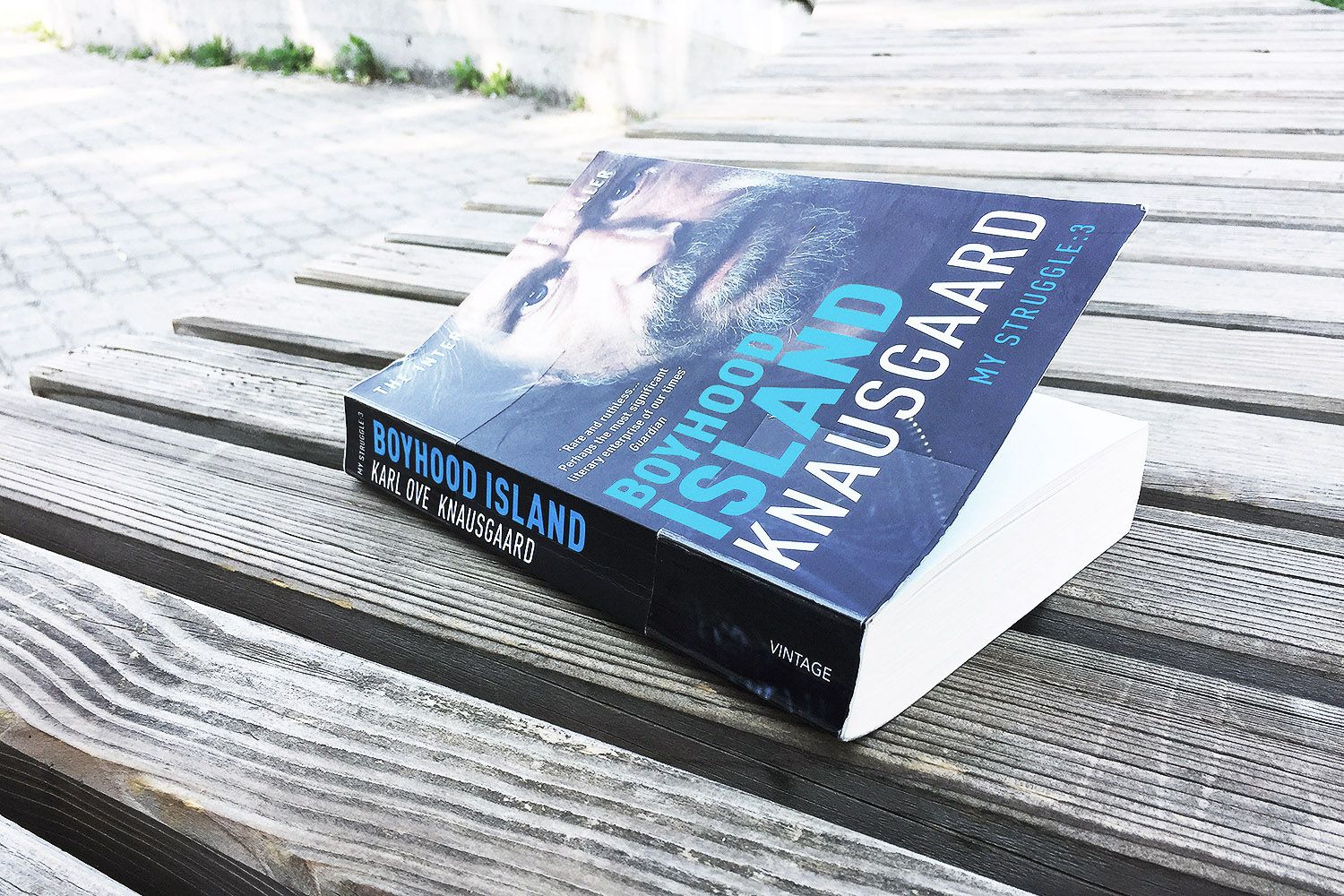
Čisto iskreno povedano sem bila po fantastičnih prvem in drugem delu Knausgårdovega Boja prepričana, da ju tretji – ki se v angleškem prevodu glasi Boyhood Island in v katerem pisatelj opisuje svoja otroška in zgodnjepubertetniška leta, ki jih je preživljal na odročnem otoku Tromøy – zlepa ne bo dosegel. A je ravno tako – če ne še kanček bolj – odličen kot njegova predhodnika.
Podobno kot v prvem delu je tudi tokrat v ospredju oče in njegova neracionalno trda vzgoja, v kateri svojemu občutljivemu sinu ne dovoljuje ničesar in ga krivi za vse: o prijateljih in rojstnodnevnih praznovanjih v hiši lahko samo sanja, govorjenje med jedjo ni dovoljeno, vstop na trato ob hiši strogo prepovedan. Očetov bes lahko izzove že najmanjše premikanje na zadnjih sedežih avtomobila. Hruško sme jesti brez da bi mu po bradi stekla ena samcata kaplja soka. Pojé kosmiče s pokvarjenim mlekom, ker se boji očetove reakcije. Ker je dan poprej pojedel dve jabolki (smel pa bi le eno), ga oče posede za mizo in ga, da bi ga naučil lekcije, prisili, da poje več jabolk, enega za drugim, dokler mu ne gre na bruhanje. Ko mu Karl Ove nekega dne s travnika prinese rože, jih s posmehom zabriše v smeti.
“One might imagine that these photos represent some kind of memory, that they are reminiscences, except that the ‘me’ reminiscences usually rely on is not there, and the question is then of course what meaning they actually have. I have seen countless photos from the same period of friends’ and girlfriends’ families, and they are virtually indistinguishable. The same colours, the same clothes, the same rooms, the same activities. But I don’t attach any significance to these photos, in a certain sense they are meaningless, and this aspect becomes even more marked when I see photos of previous generations, it is just a collection of people, dressed in exotic clothes, doing something which to me is unfathomable. It is the era that we take photos of, not the people in it, they can’t be captured. Not even the people in my immediate circle can. Who was the woman posing in front of the stove in the flat in Thereses gate, wearing a light blue dress, one knee resting against the other, calves apart, in this typical 1960s posture? The one with the bob? The blue eyes and the gentle smile that was so gentle that it barely even registered as a smile? The one holding the handle of the shiny coffee pot with the red lid? Yes, that was my mother, my very own mum, but who was she? What was she thinking? How did she see her life, the one she had lived so far and the one awaiting her? Only she knows, and the photo tells you nothing. An unknown woman in an unknown room, that is all. And the man who, ten years later, is sitting on a mountainside drinking coffee from the same red Thermos top, as he forgot to pack any cups before leaving, who was he? The one with the well-groomed black beard and the thick black hair? The one with the sensitive lips and the amused eyes? Yes, of course, that was my father, my very own dad. But who he was to himself at this moment, or at any other, nobody knows. And so it is with all these photos, even the ones of me. They are voids; the only meaning that can be derived from them is that which time has added.
…
It felt good holding her, and cycling with her was fun. Grandma was the only person who touched Yngve and me, the only person who gave us hugs and stroked our arms. She was also the only person who played with us. Dad might do it at Christmas, but we always did the things he wanted to do, like playing mastermind or chess or Chinese checkers or yatzy or crazy eights or poker with matchsticks. Mum joined in when we played, but we did most things with her, either on the kitchen table at home or at the arts and crafts workshop in Kokkeplassen, and it was fun, but not like with grandma, who didn’t mind doing what we were doing and followed with interest when Yngve showed her something from his chemistry set, for example, or helped me when I was doing a jigsaw puzzle.
…
For if there was someone there, at the bottom of the well that is my childhood, it was her, my mother, mum. She was the one who made all our meals and gathered us around her in the kitchen every evening. She was the one who went shopping, knitted or sewed our clothes; she was the one who repaired them when they fell apart. She was the one who supplied the bandage when we had fallen and grazed our knees; she was the one who drove me to the hospital when I broke my collarbone, and to the doctor’s when I, somewhat less heroically, had scabies. She was the one who was out of her mind with worry when a young girl died from meningitis and at the same time I got a cold and a bit of a stiff neck. I was bundled straight into the car, off to Kokkeplassen, her foot flat on the accelerator, concern flashing from her eyes. She was the one who read to us, she was the one who washed our hair when we were in the bath and she was the one who laid out our pyjamas afterward. She was the one who drove us to football training in the evening, the one who went to parents’ meetings and sat with other parents at our end-of-term parties and took pictures of us. She was the one who stuck the photos in our albums afterwards. She was the one who baked cakes for our birthdays and cakes for Christmas and buns for Shrovetide.
All the things mothers do for their sons, she did for us. If I was ill and in bed with a temperature she was the one who came in with a cold compress and placed it on my forehead, she was the one who put the thermometer up my backside to take my temperature, she was the one who came in with water, juice, grapes, biscuits, and she was the one who got up in the night and came in wearing her nightdress to see how I was.
She was always there, I know she was, but I just can’t remember it.
I have no memories of her reading to me and I can’t remember her putting a single bandage on my knees or being present at a single end-of-term event.
How can that be?
She saved me because if she hadn’t been there I would have grown up alone with dad, and sooner or later I would have taken my life, one way or another. But she was there, dad’s darkness had a counterbalance, I am alive and the fact that I do not live my life to the full has nothing to do with the balance of my childhood. I am alive, I have my own children and with them I have tried to achieve only one aim: that they shouldn’t be afraid of their father.
They aren’t. I know that.
When I enter a room, they don’t cringe, they don’t look down at the floor, they don’t dart off as soon as they glimpse an opportunity, no, if they look at me, it is not a look of indifference, and if there is anyone I am happy to be ignored by it is them. If there is anyone I am happy to be taken for granted by, it is them. And should they have completely forgotten I was there when they turn forty themselves, I will thank them and take a bow and accept the bouquets.
…
Dad knew what the situation was. Lack of self-knowledge was not one of his failings. One evening at the beginning of the 1980s he said to Prestbakmo that it was mum who had saved his children. The question is whether it was enough. The question is whether she was not responsible for exposing us to him for so many years, a man we were afraid of, always, at all times. The question is whether it is enough to be a counterbalance to the darkness.
She made a decision: she stayed with him, she must have had her reasons.
…
The sole really unpredictable factor in this life, from autumn to winter, spring to summer, from one school year to the next, was dad. I was so frightened of him that even with the greatest effort of will I am unable to re-create the fear; the feelings I had for him I have never felt since, nor indeed anything close.
His footsteps on the stairs — was he coming to see me?
The wild glare in his eyes. The tightness around his mouth. The lips that parted involuntarily. And then his voice.
Sitting here now, hearing it in my inner ear, I almost start crying.
His fury struck like a wave, it washed through the rooms, lashed at me, lashed and lashed and lashed at me, and then it retreated. Then it could be quiet for several weeks. However, it wasn’t quiet, for it could just as easily come in two minutes as two days. There was no warning. Suddenly, there he was, furious. Whether he hit me or not made no difference, it was equally awful if he twisted my ear or squeezed my arm or dragged me somewhere to see what I had done, it wasn’t the pain I was afraid of, it was him, his voice, his face, his body, the fury it emitted, that was what I was afraid of, and the terror never let up, it was there for every single day of my entire childhood.
After the confrontations I wanted to die. Dying was one of the best, most enjoyable fantasies I had. He would have fun then. He would be standing there thinking about what he had done. He would be feeling remorse then. Oh, what remorse he would feel! I visualised him standing there and wringing his hands in despair with his head turned to heaven in front of the tiny coffin where I lay, with my prominent teeth, unable to pronounce my r’s.
…
Inside my room there was only one thing I longed for, and that was to grow up. To have total control over my own life. I hated dad, but I was in his hands, I couldn’t escape his power. It was impossible to exact my revenge on him. Except in the much-acclaimed mind and imagination, there I was able to crush him. I could grow there, outgrow him, place my hands on his cheeks, and squeeze until his lips formed the stupid pout he made to imitate me, because of my protruding teeth. There, I could punch him in the nose so hard that it broke and blood streamed from it. Or, even better, so that the bone was forced back into his brain and he died. I could hurl him against the wall or throw him down the stairs. I could grab him by the neck and smash his face against the table. That was how I could think, but the instant I was in the same room as he was, everything crumbled, he was my father, a grown man, so much bigger than me that everything had to bend to his will. He bent my will as if it were nothing.”
Res škoda, da sem že na polovici.